Everything about Cusco’s Lord of Earthquakes is deeply symbolic and ties him to Quechua culture.
“Ñucchu, ñucchu, ñucchu!”
Women holding up small plastic bags filled with little red flowers pushed their way past me through the crowd. I was waiting in front of Cusco’s Santa Teresa Church for the Lord of Earthquakes, the city’s patron, to arrive on his procession from the cathedral.
In Cusco, the most important day of Holy Week isn’t Palm Sunday, Ash Wednesday, Good Friday or even Easter. It’s the Monday after Palm Sunday, which isn’t a particularly important day for most Catholics around the world.
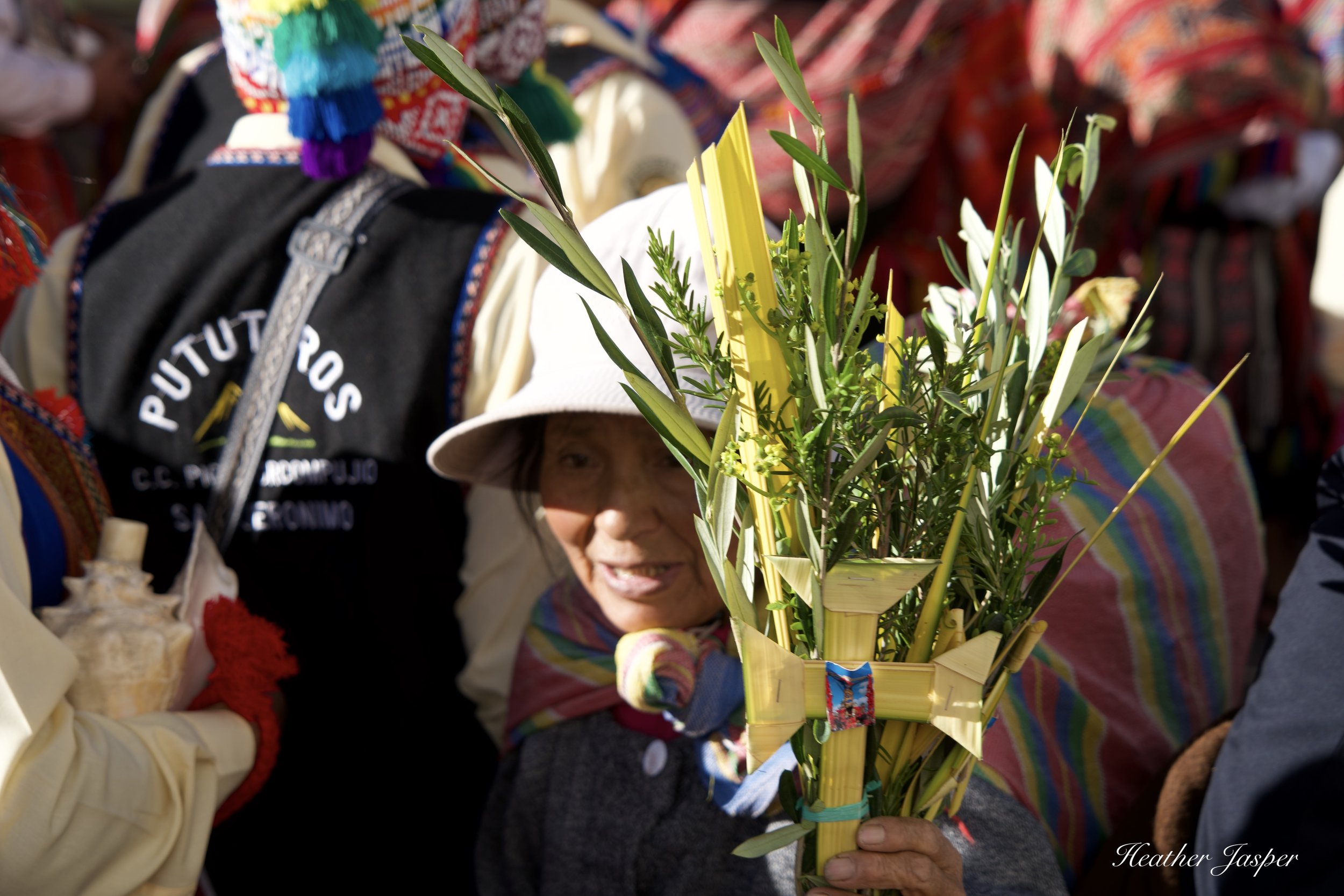
Yes, Palm Sunday is important in Cusco, but not as important as the day of the Lord of Earthquakes.
The Earthquake of 1650
In 1650, a massive earthquake shook Cusco on the Monday of Holy Week, followed by powerful aftershocks. At the time, people thought of it as a series of earthquakes and as the ground continued to shake, houses fell and people feared for the statues of Saints, Virgins and Jesus in their churches. Only when they brought out a statue of Jesus on the cross, called Santo Cristo de la Buena Muerte, did the earthquakes (aftershocks) stop.
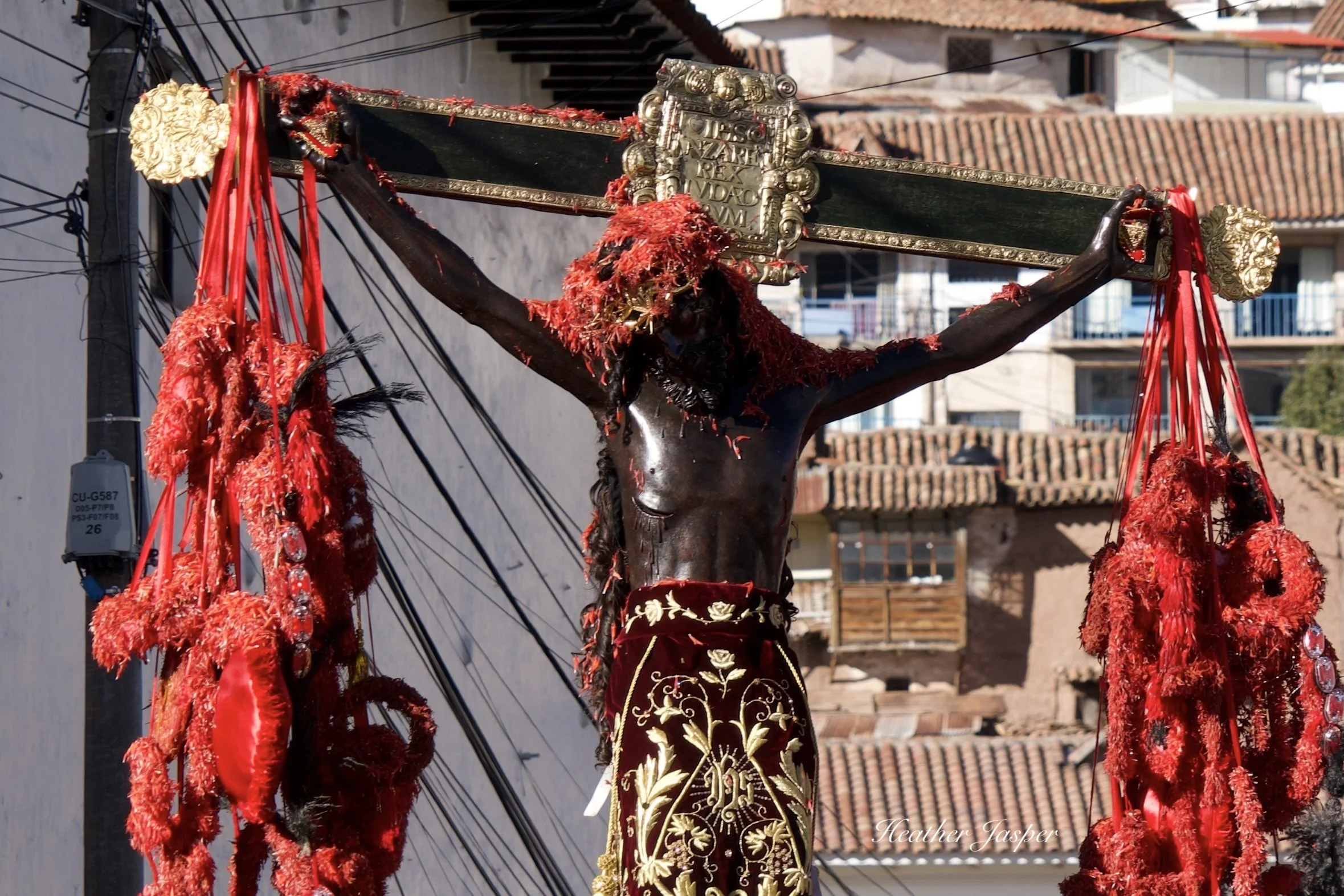
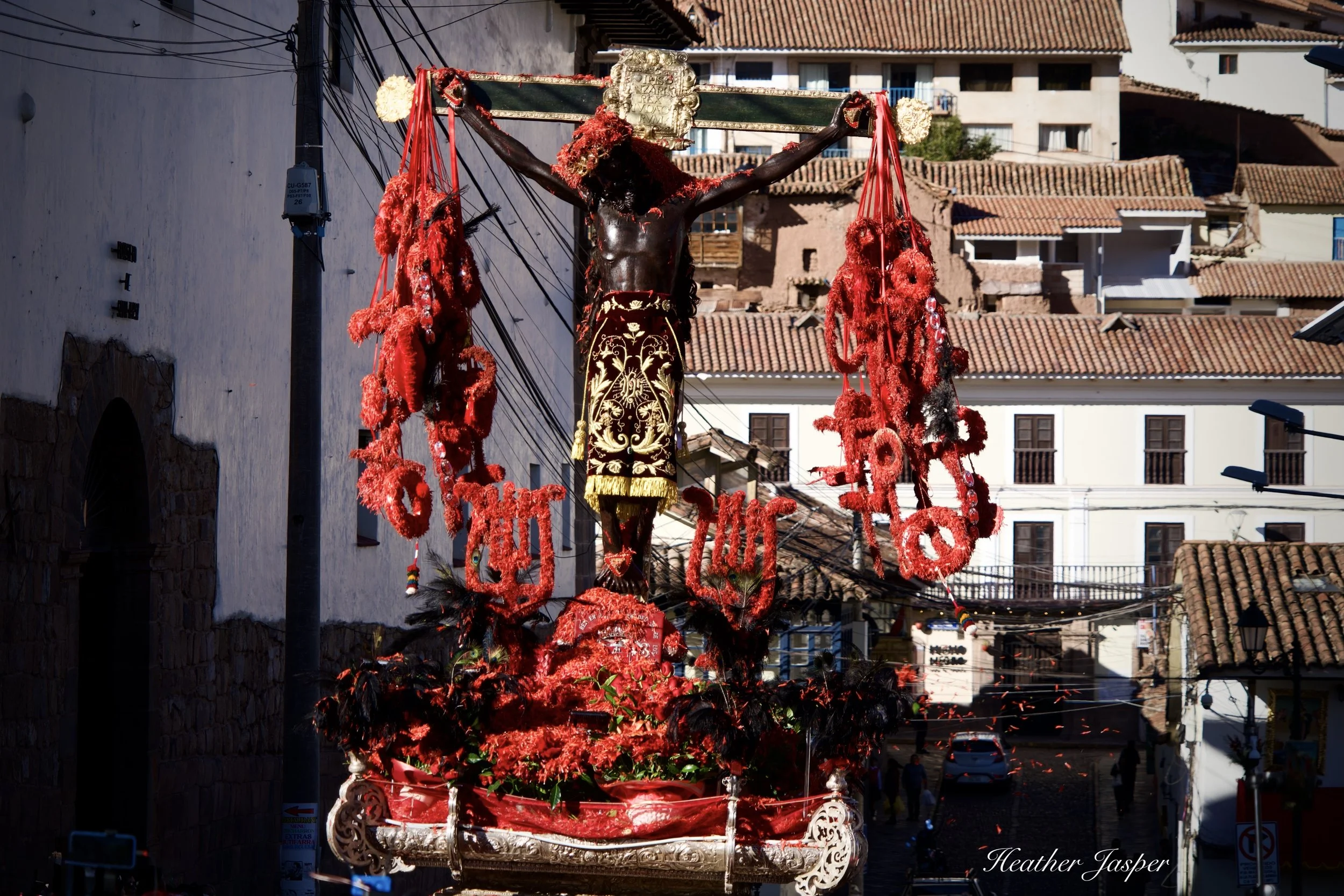
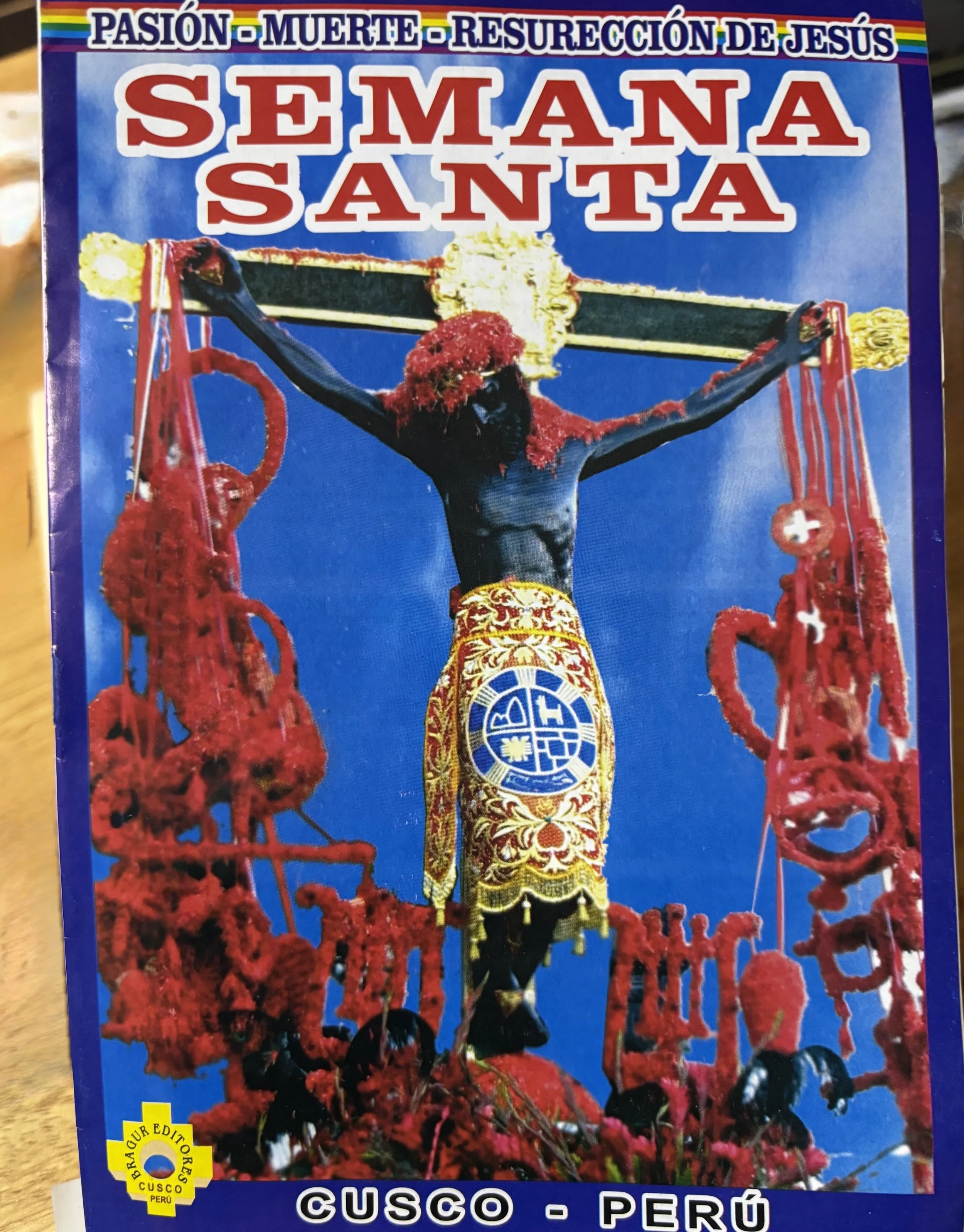
The wooden Taytacha is much darker than most statues of Jesus.
Santo Cristo de la Buena Muerte
This image of Christ was carved of wood, rather than made of ceramic like many statues brought from Spain to evangelize the Indigenous peoples of Peru. Of course, there are no photos from 1650, but according to oral history, the statue was a natural light brown wood, not painted. According to popular belief, over the centuries, the smoke from candles and incense has darkened the wood so that now Jesus appears a deep brown, almost black.
Some Cusqueñians believe that the color change was a miracle, an act of God to show Andeans with dark skin that this image of Christ represents them. This is their Jesus.
Cusco’s Frequent Earthquakes
The Andes are a seismically active region, so it makes sense that Cusco’s patron would be related with protection from earthquakes. After 1650, the image’s name was changed from Santo Cristo de la Buena Muerte to Señor de los Temblores, Lord of Earthquakes. It was moved from the Triunfo Chapel to the city’s cathedral.
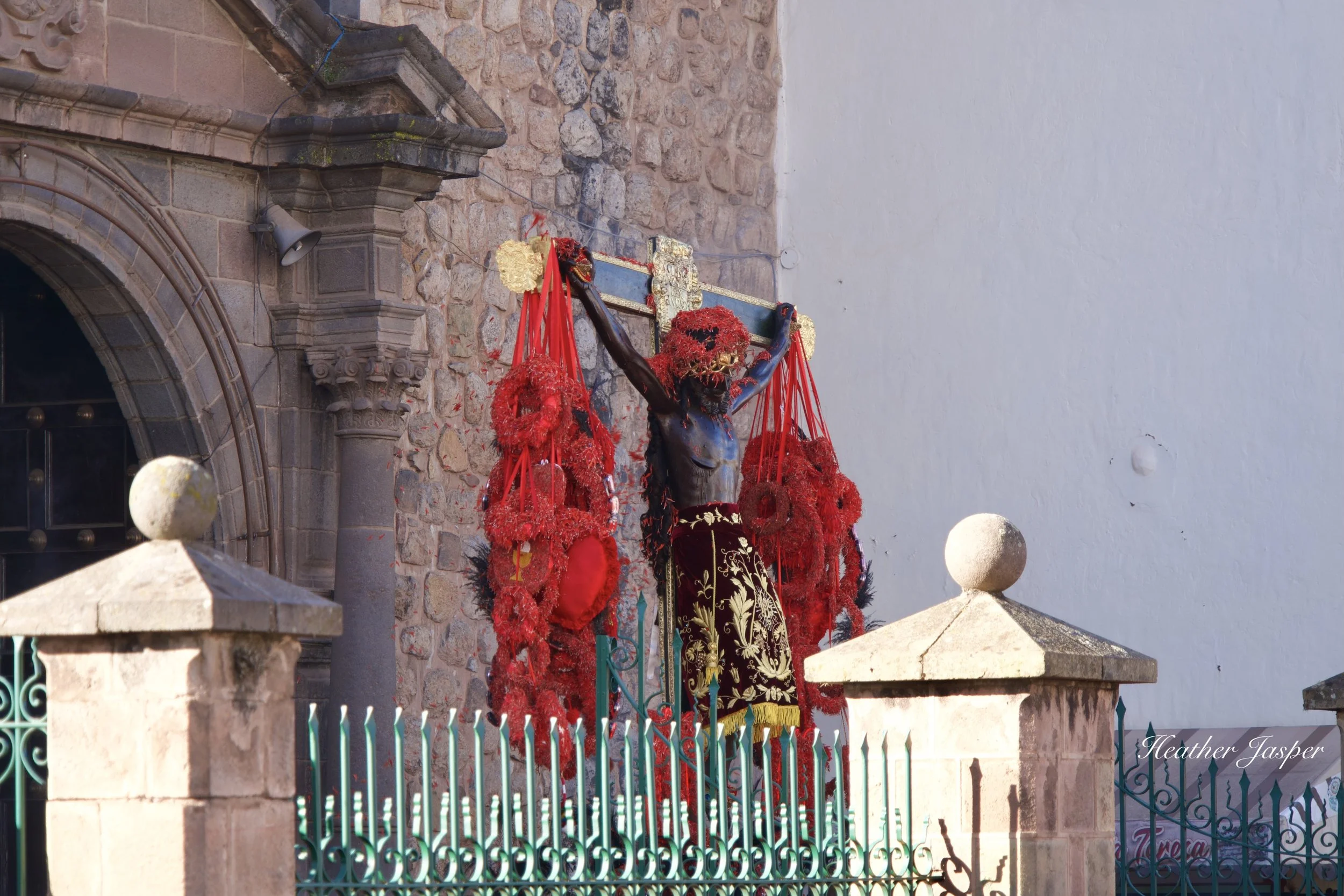
The bearers turn and walk backwards towards the doorway of the Santa Teresa Church so Taytacha is always facing the crowd.
The Lord of Earthquakes
Today, the Señor de los Temblores is commonly called Taytacha, a Quecha word that means “our father.” The ending -cha is an affectionate Quechua term. He resides in the cathedral and people pray to him all year for protection from earthquakes. The only time he leaves the cathedral is for the procession on Holy Monday. He used to go in a procession only around the plaza but as congregations of other nearby churches have asked for his visit, the procession is extended. This year, I saw him visit the Santa Teresa Church, after which he was going to San Francisco and La Merced. Next year the congregations of Belén have asked for his visit, which will extend the procession late into the night.
When to see the Lord of Earthquakes?
In the morning, the Bishop of Cusco performs mass each hour from 8am to noon, since far more people want to attend mass than can possibly fit in the cathedral at once. This is generally more people than attend mass on Palm Sunday or Easter. At noon, the statue is taken down from his usual spot, placed on an anda (a platform with long handles for the bearers) and brought to the doorway of the cathedral. The procession used to last until 4pm but this year he didn’t arrive at Santa Teresa until 4pm and he still had a long way to go before he made it back to the cathedral.
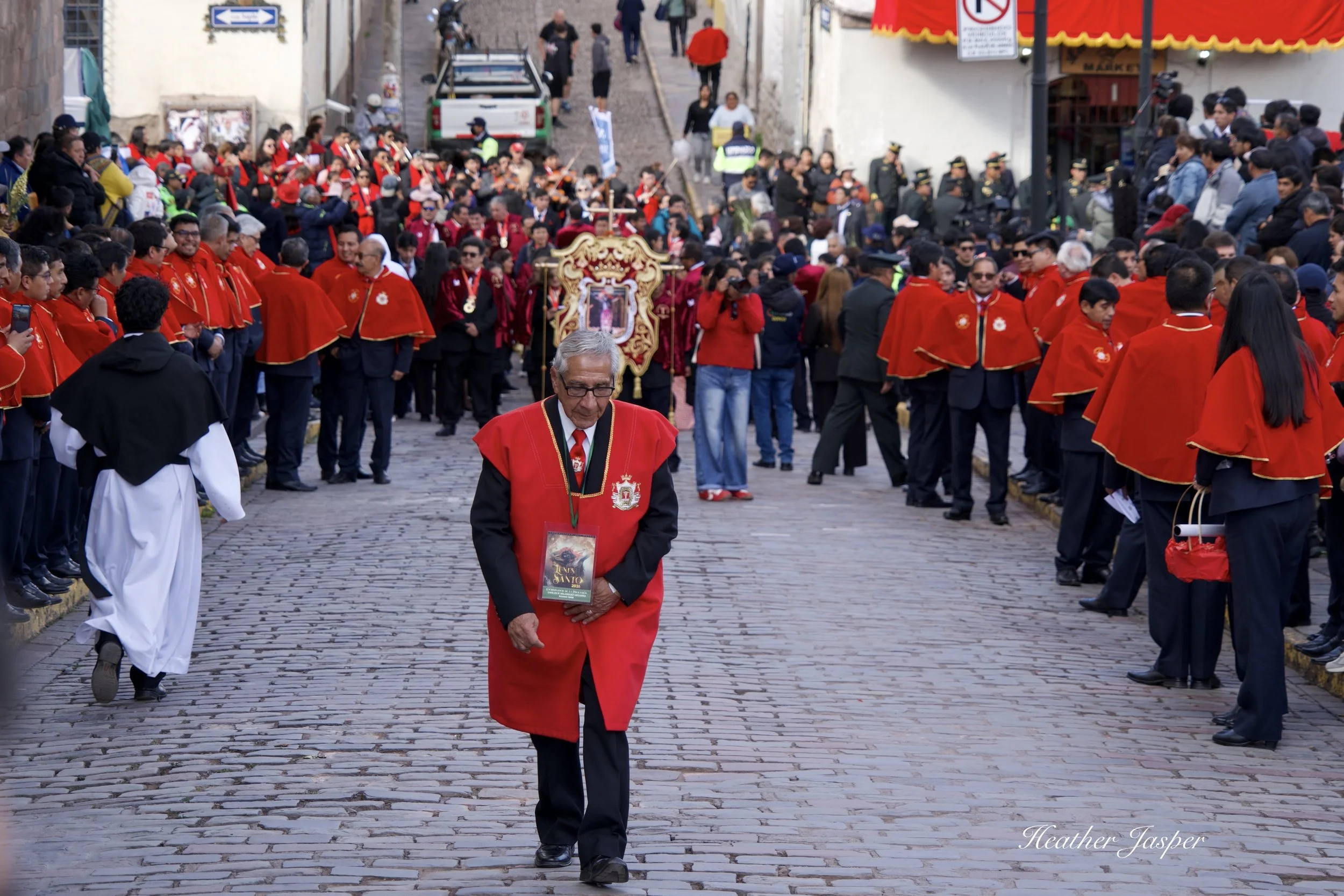
The many brotherhoods that lead Taytacha’s procession wear red and black.
Symbolism of the Lord of Earthquakes
Taytacha, as he is affectionately called by Cusqueñians, is literally covered with symbolism. Just before he exits the cathedral for the procession, his cross is draped with crowns, crosses and scales made of the red ñucchu flower. (Pronounce the two Cs separately: ñuc-chu). The anda also has lots of peacock feathers, which reportedly used to be condor feathers, highly symbolic in Quechua culture. The crowns symbolize Christ’s crown of thorns, the crosses his crucifixion and the scales represent justice and his equal acceptance of all people, implying all colors of skin.
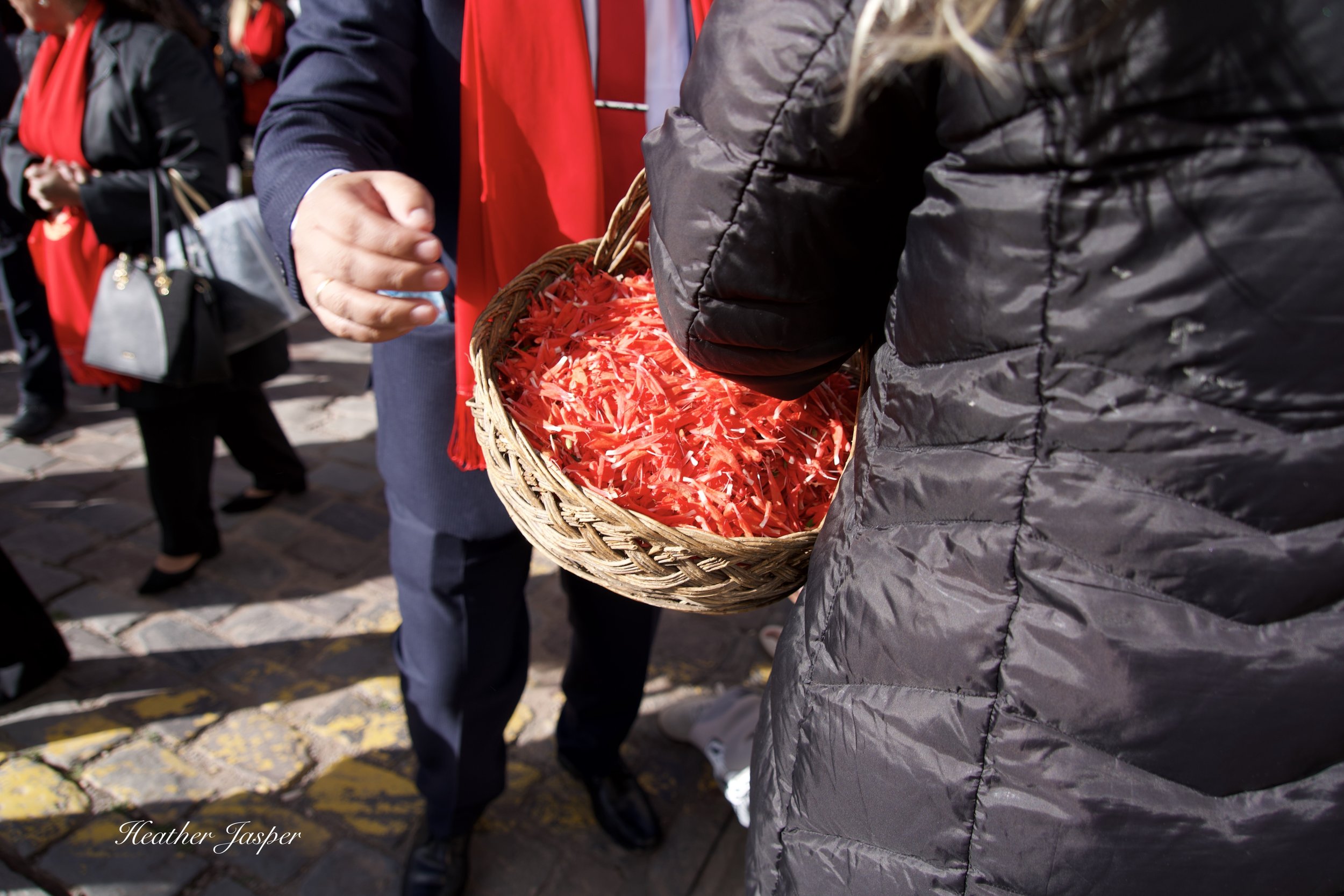
People carry baskets of fresh ñucchu flowers all along Taytacha’s route to shower him with flowers.
The Ñucchu Flower
The red ñucchu (ñuc-chu) grows on low bushes and blooms at the end of the rainy season, which more or less coincides with Holy Week every year. The red color and the flower itself were very important in Incan culture. You’ll find ñucchu in the earliest paintings of Incan royalty, when the panacas (royal families) that sided with the Spanish sat for portraits in their finest clothes. The ñucchu was woven into the decorations of women’s robes and shawls, immortalized by the Spanish painters sent to Peru.
Where to see Incan use of ñucchu?
In Cusco, the best place to see how important the ñucchu was for the Inca is at the Museo Inka, less than a block from the cathedral. You’ll find the paintings mentioned above, plus wooden ceremonial vessels called qero. A qero was usually filled with chicha, a fermented corn beverage, during ceremonies, much the way Catholics use a chalice of wine. Many of the qeros in the Museo Inka are painted with ñucchu.
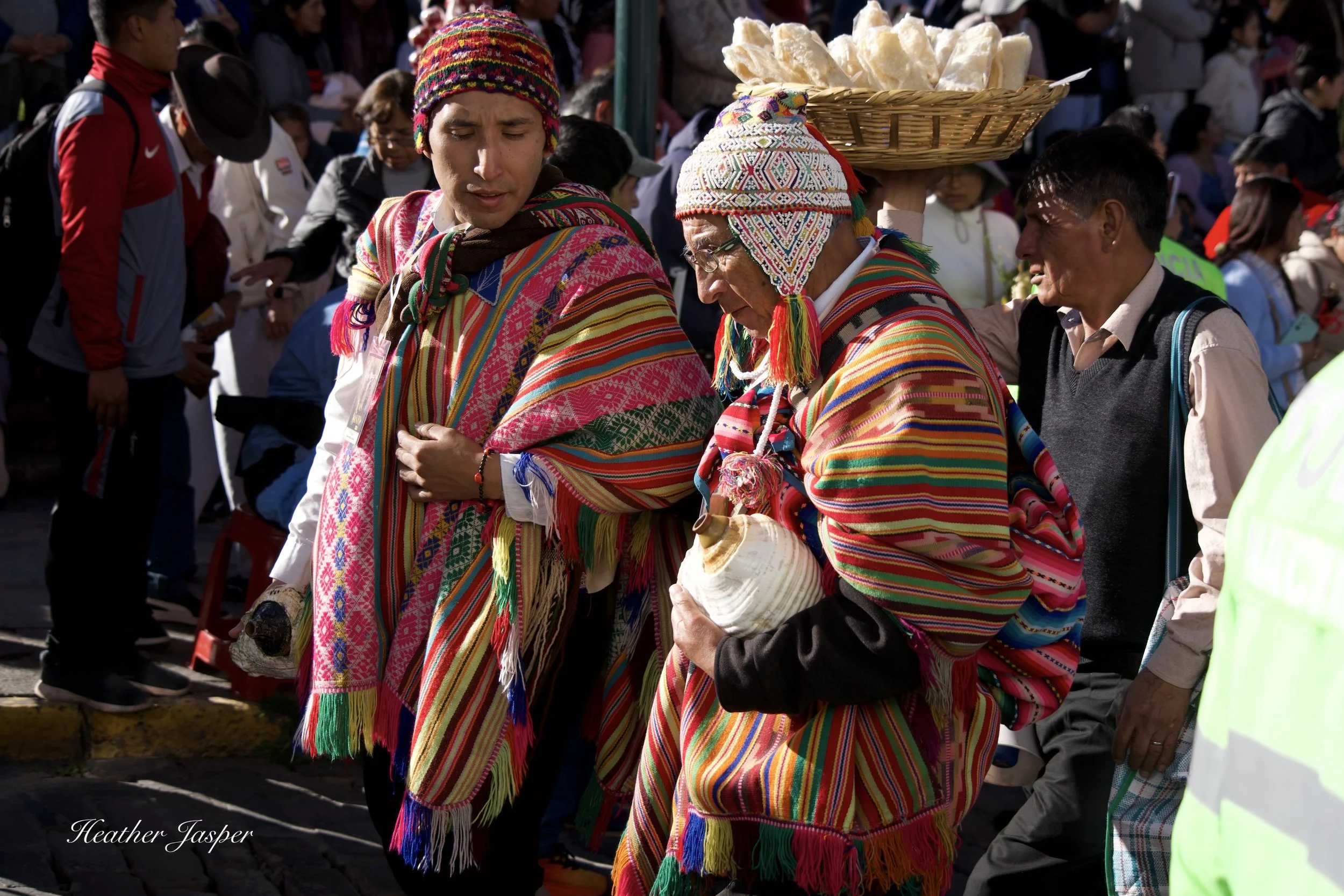
Today, Cusqueñians proudly wear colorful ponchos, chullu hats and use the pututu to announce an important arrival.
Preserving Quechua Culture
During the colonial period, the Quechua language was forbidden, as were most of their ceremonies in Spain’s attempt to erase their culture. People still spoke Quechua at home, in secret, but had to pretend to only speak Spanish in public. Their sacred sites, called huacas, were destroyed or desecrated to prevent people from continuting to worship the Pachamama (Mother Earth) and Wiracocha (Pachamama’s male counterpart). Contrary to what the Spanish claimed, the sun wasn’t considered a god. Pachamama and Wiracocha were the center of Andean spirituality.
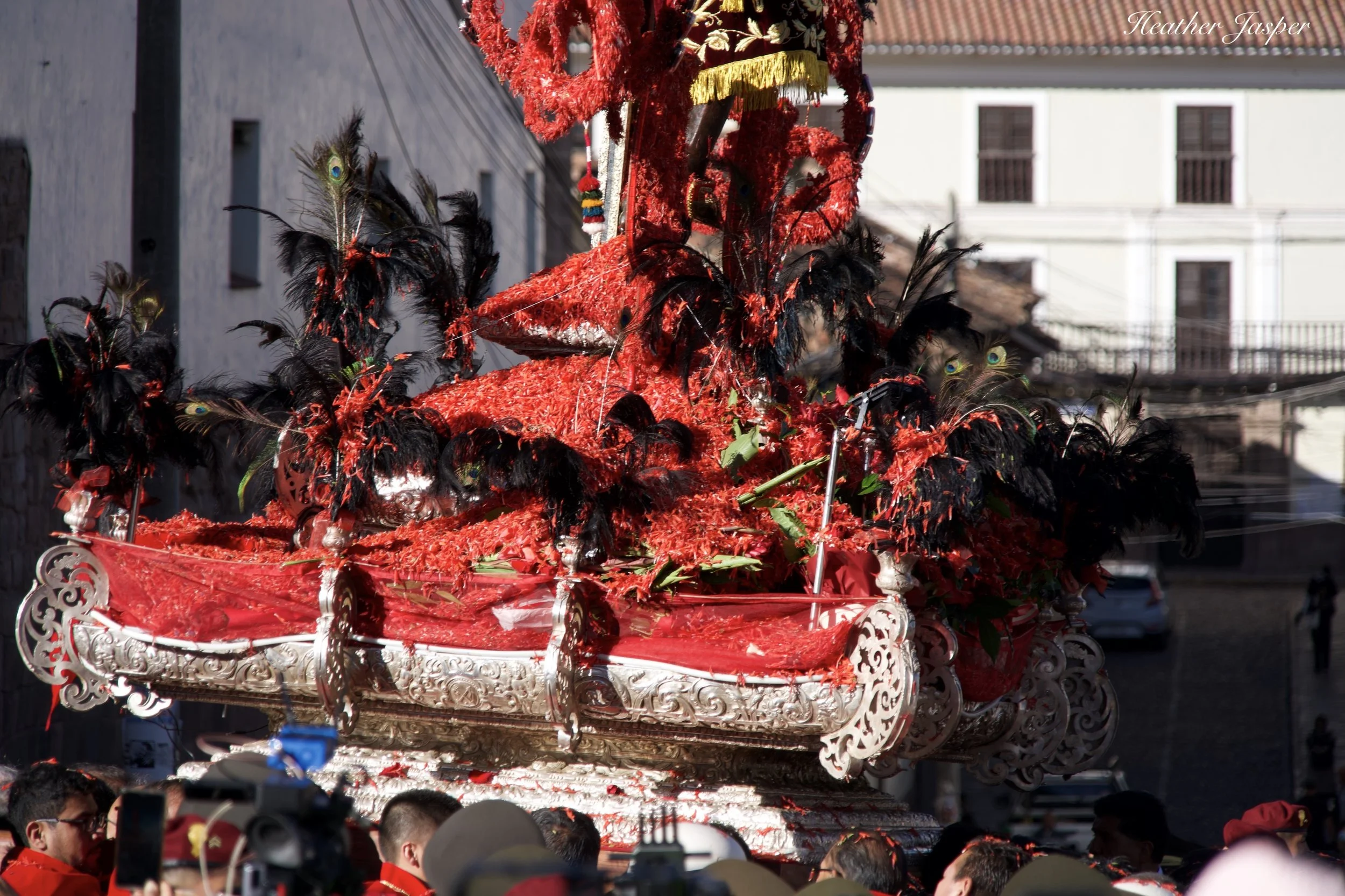
Taytacha and everybody carrying him are covered with ñucchu by the end of Holy Monday.
Ñucchu Never Disappeared
Perhaps because the Spanish never realized the symbolic importance of ñucchu, the flower was never forbidden like other elements of Quechua culture. You’ll find it in all kinds of art throughout the colonial period: paintings, qeros, ceramics and woven into textiles.
Incan vs. Quechua
On a sidenote, the word Inca refers to the ruler, The Inca, and to the Inca’s family and culture. Quechua refers to the culture and language of common people. The Inca spoke Puquina with his royal family and the panacas, but he spoke Quechua when he addressed commoners. Andean refers to anybody from the Andes, both the royal panacas and the common Quechua population.
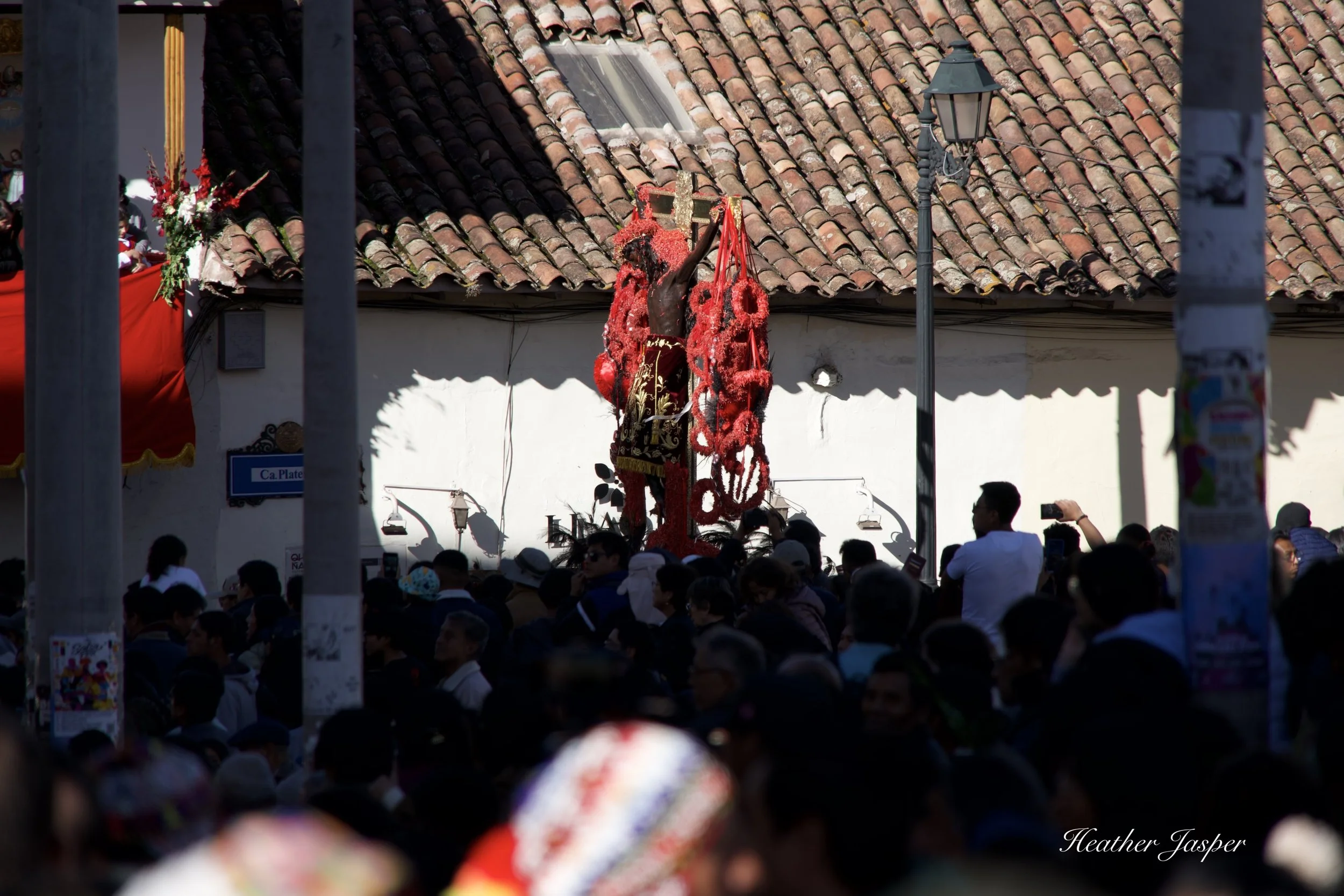
Thousands of people line the streets where Taytacha is carried from church to church around Cusco.
Cusco’s Christ
The Lord of Earthquakes is not only called Taytacha, a Quechua name, visually almost everything about him is symbolic of Quechua culture: his dark skin, his ñucchu flowers, his feathers and even his procession. During Incan times, the sacred mummies of former Incas were taken from their homes, where their families continued to care for them as if they were still alive, and went in procession around Cusco for important holidays and ceremonies.
Incan Mummy Processions
As the Inca’s capital city, Cusco was full of sacred temples and palaces. For important ceremonies and rituals, the mummies of former Incas were brought from their homes and carried in procession around Haukay Pata, which the Spanish turned into their Plaza de Armas. They demolished Incan temples and built Spanish churches on top, often with the same stones that were carved for the temples. When statues of Saints, Virgins and Jesus go in procession around Cusco’s Plaza de Armas and visit the nearby churches, they are following the same path that Incan mummies took in their processions.
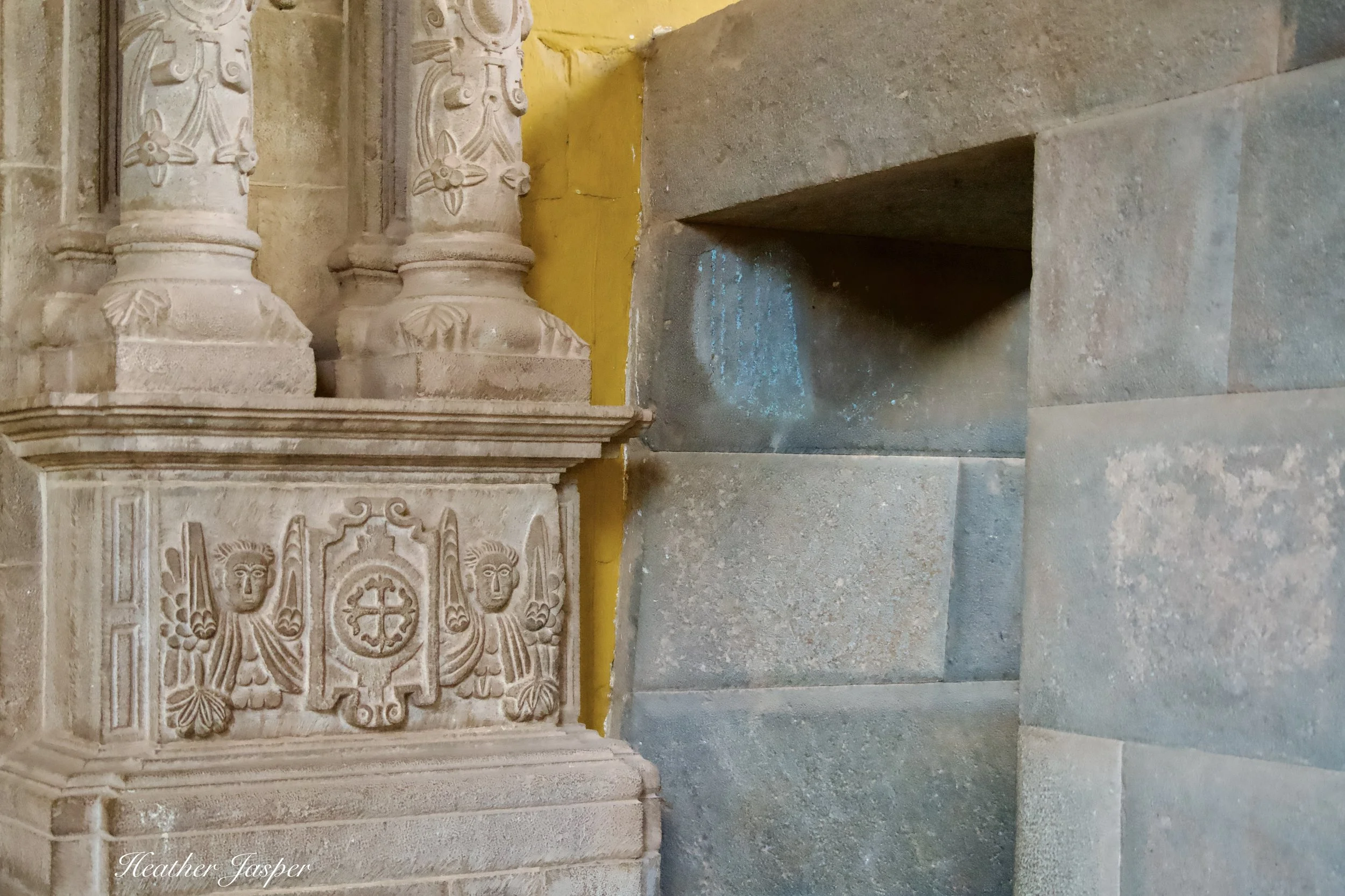
The 1950 earthquake severely damaged the Santo Domingo church, revealing Inca architecture hidden for centuries, which you can visit today as part of the Qorikancha.
The 1950 Earthquake
In 1950, yes exactly three hundred years after the earthquake that Taytacha stopped, another massive quake shook Cusco. Buildings collapsed and even the belltower of the cathedral fell. Cusqueñians’ interest in the Lord of Earthquakes renewed in their hope to prevent further earthquakes. The 1940s and 50s also saw a renewed respect for Quechua language and culture, thankfully saving both before they disappeared forever. The Guevara family was instrumental in reviving Cusco’s adoration of Taytacha.
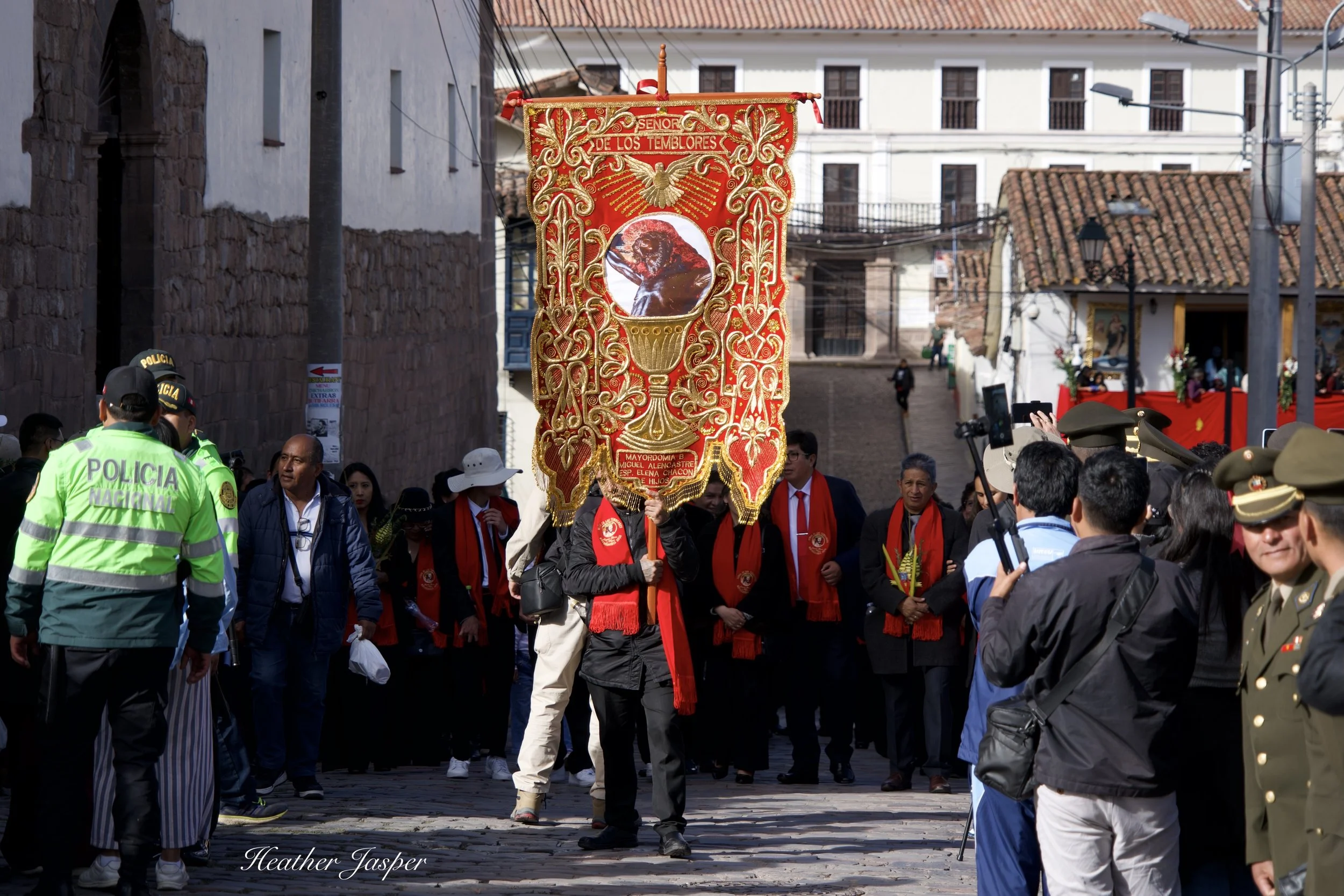
This standard is of the mayordomo, one of the families that finances the procession. Yes, that’s real gold.
The Guevara Family
Today, in preparation for the Lord of the Earthquakes’ procession on Holy Monday, the many descendants of the Guevara family scour the hills around Cusco for ñucchu. They spend all Palm Sunday gathering wild ñucchu flowers where it grows along streams and then all night with needle and thread, sewing the little tubular flowers into crowns, crosses and scales. The Guevara family has made all the ñucchu decorations this since 1954, but they are not the only group to participate in Taytacha’s procession.
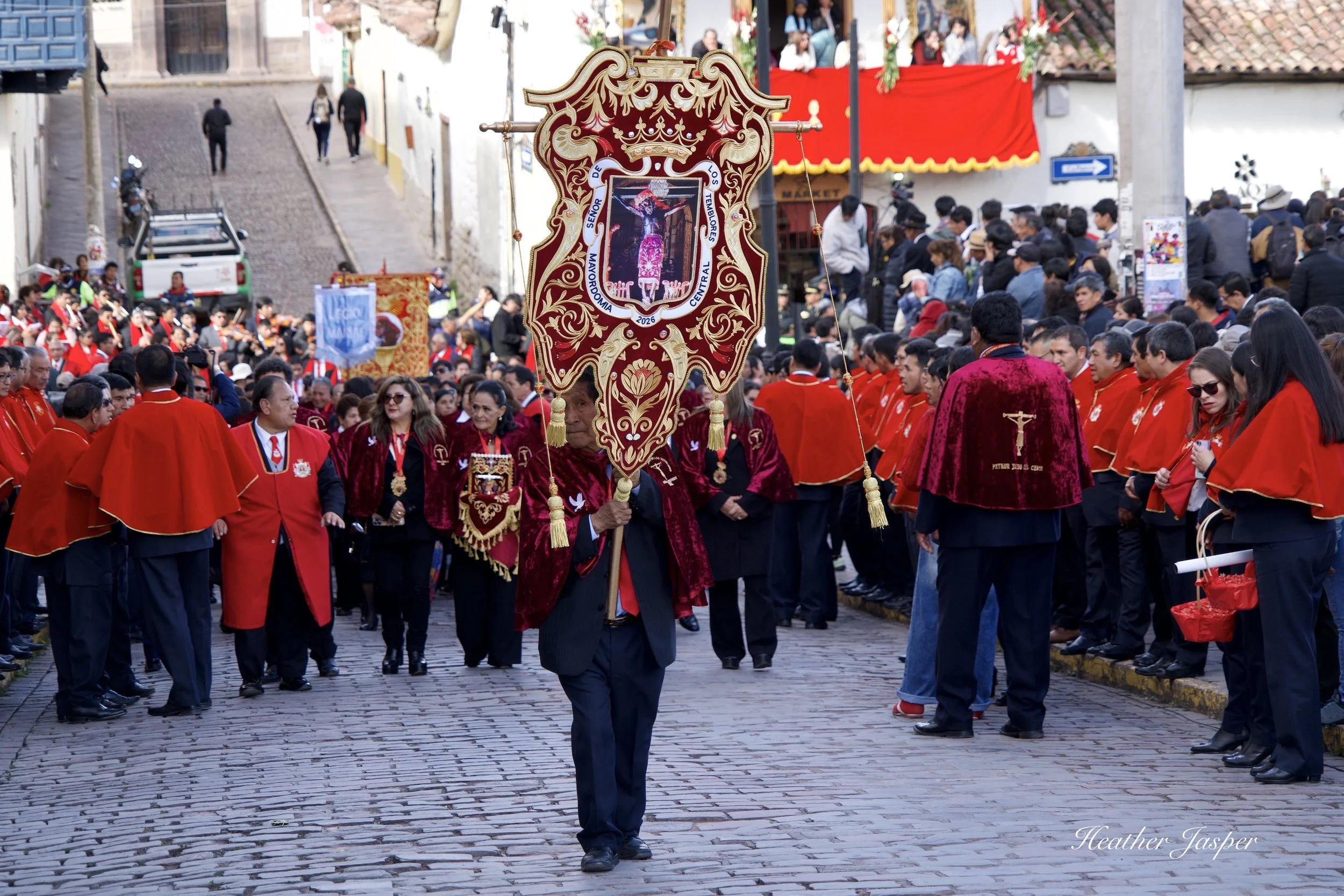
This standard announces another “mayordomia” and the woman carrying a small box behind has the “demanda.”
Brothers and Sisters
There are 32 hermandades devoted to Taytacha. Some are all men, hermandad meaning brotherhood in this case. Some are all women, as hermandad can also mean sisterhood. They lead the procession, each with a standard bearer announcing their presence and participation. Most are dressed in black to symbolize mourning for Christ’s death but with red shawls or sashes, the color of ñucchu and Incan royalty. In Quechua culture, black is also a sacred color and symbolizes purity, hence the black feathers on Taytacha’s anda, the heavy platform carried by the hermandad who act as his cargadores, carrying the heavy anda throughout the city.
Pututeros and Qhapaq Ñustas
Any Cusqueñian (or tourist or photographer) can walk before the official procession of hermandades, or follow at the end. Two groups that church officials do not approve of, but who are free to take part in the procession, are the Pututeros and Qhapaq Ñustas, dressed in traditional Andean clothes.
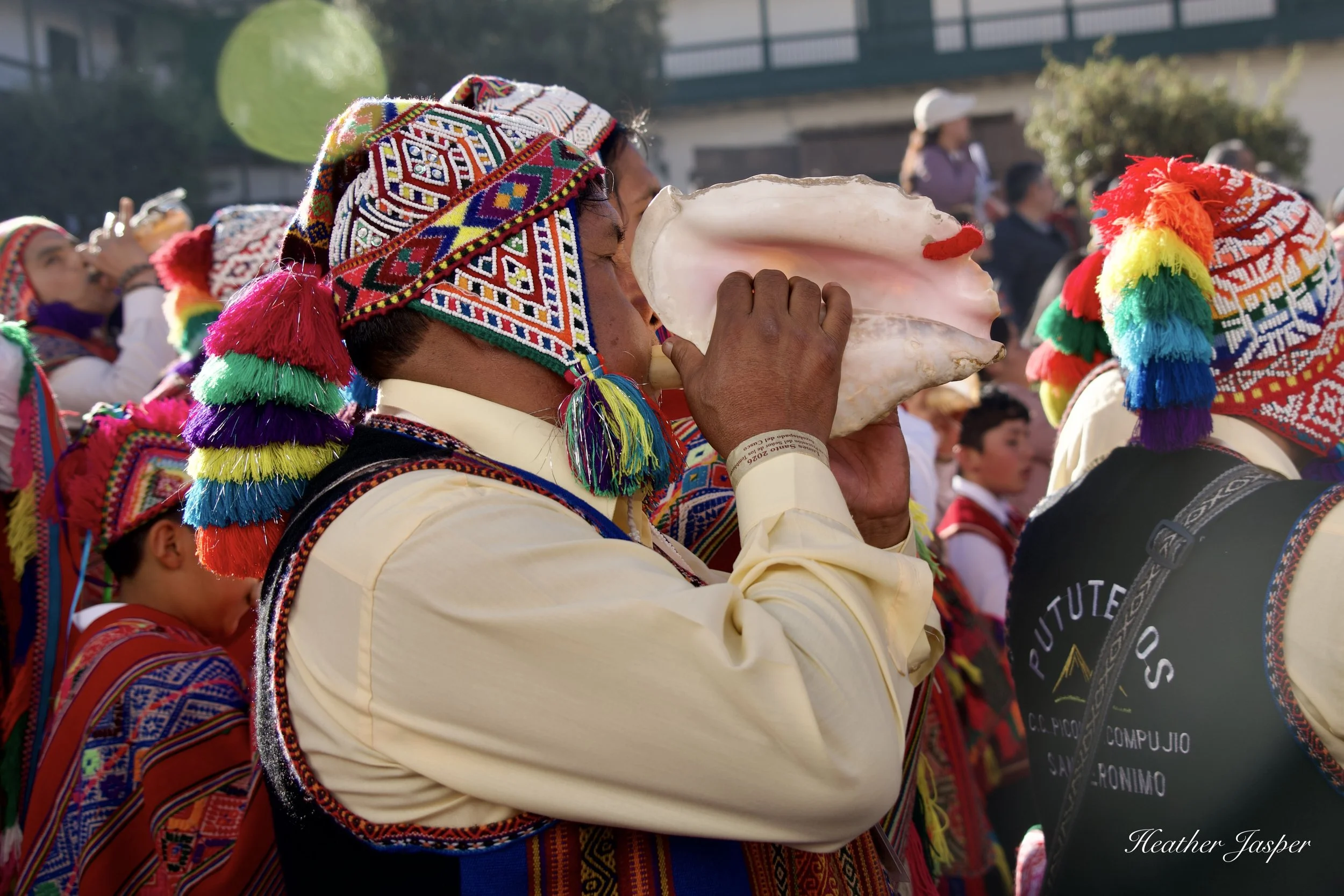
The pututeros blow three times in unison to announce Taytacha’s arrival at the Santa Teresa church.
The Royal Pututu
The pututu is a conch shell, used during Incan times to announce the arrival of the Inca or important member of his panaca. Today, many cultural groups have pututus to announce the arrival of somebody important. In this procession, a group of pututeros walk backwards ahead of the procession, announcing Taytacha’s arrival. No matter what the Catholic church hierarchy think, there’s nothing they can do to prevent the pututeros from participating every year.
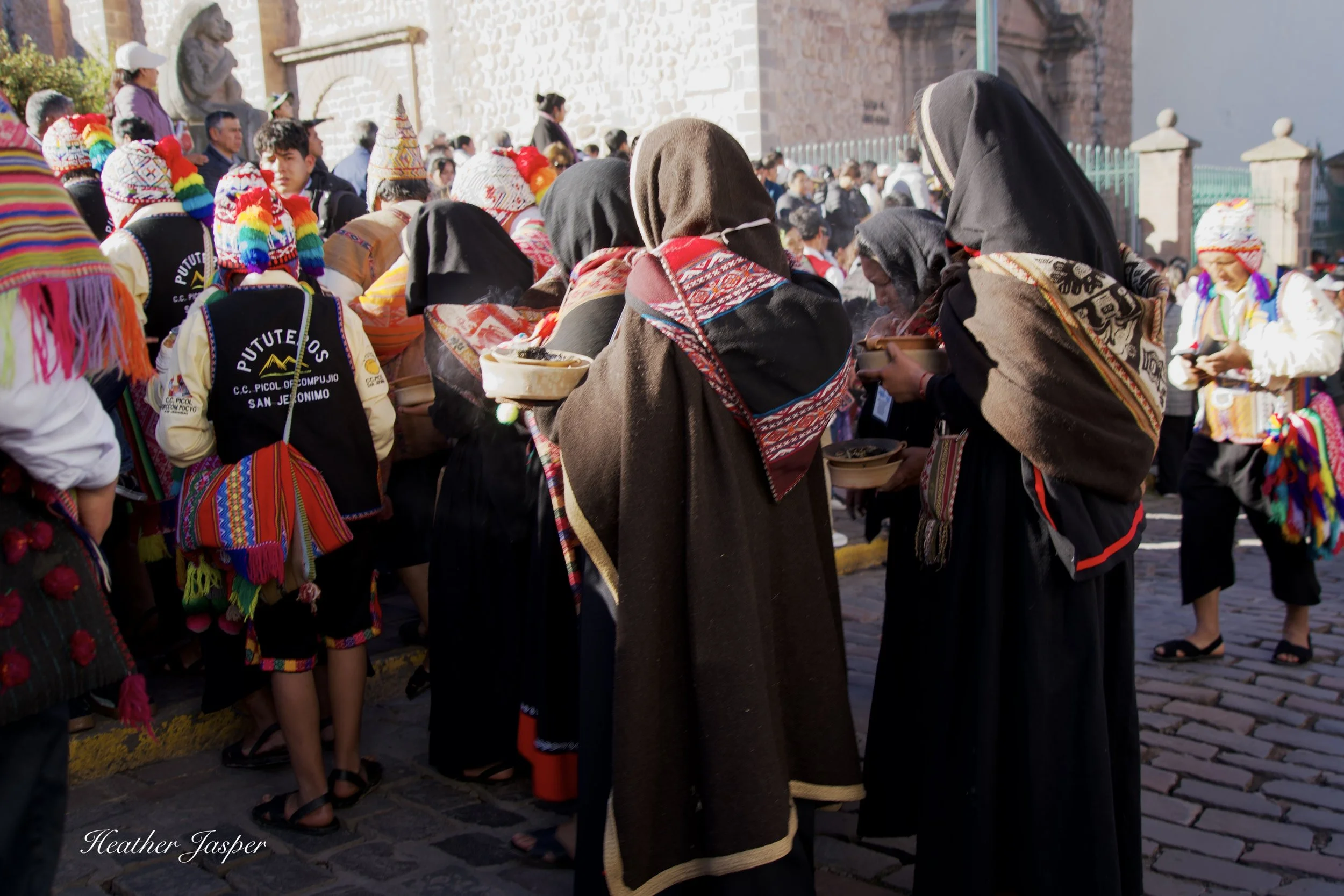
The Qhapaq Ñustas carry terra cotta bowls of incense and wear robes and colorful Quechua shawls called lliclla.
The Qhapaq Ñustas
In Quechua, the word Qhapaq means royal and in some contexts can mean rich. The word ñusta was used for young women chosen for their beauty and intelligence to live apart from society. In this procession, a group of women called Qhapaq Ñustas wear black hooded robes and walk near the pututeros, carrying incense to cleanse the path for Taytacha. They also walk backwards, never turning their backs on Taytacha and never letting the incense go out.
What is a ñusta?
During Incan times, ñustas lived in an accllawasi and spent their time making chicha and other things used in ceremonies, as anything they made was sacred. The Spanish considered them like nuns and said they were virgins. Personally, I’m not convinced that Incan culture was as obsessed with virginity as Spanish culture. Since history was written by the Spanish, you’ll always see ñustas referred to as virgins, but I don’t think their purity was dependent on never having sex. They did live apart from society, attended to by older women called mamacona, but again, I haven’t seen any proof that Incan culture was as obsessed with virginity as Spanish culture and the Catholic church.
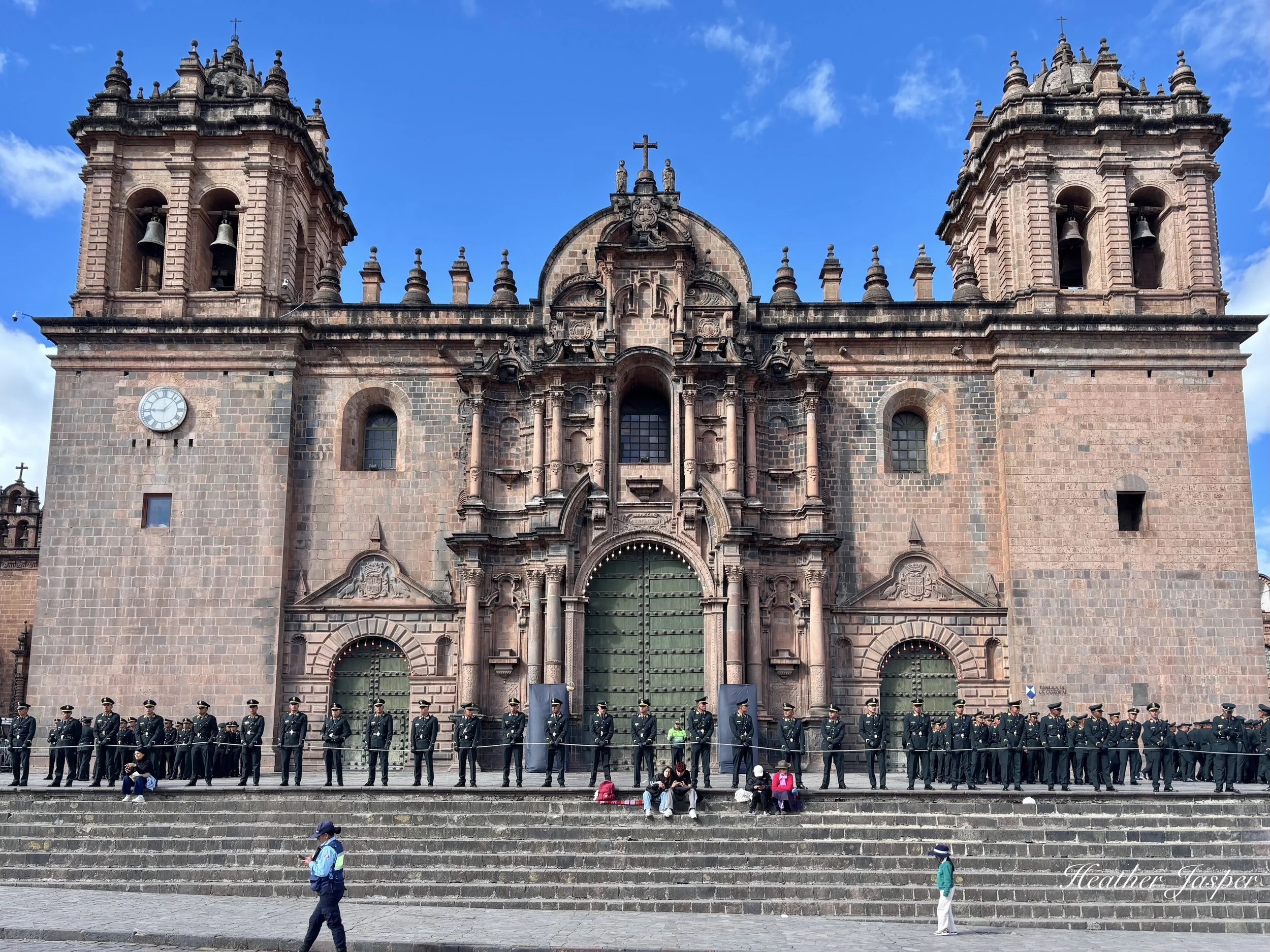
Even after Taytacha has left, police guard the front of the cathedral to keep the path open for his return that night.
How to see Taytacha?
Many Cusqueñians arrive at the cathedral at first light, hours before the first mass, so they can attend mass on the Monday after Palm Sunday. The crush of people is so great that every year a line of police have to hold the crowd back. To see Taytacha during mass or as he exits the cathedral, you have to get to the plaza by 6am. Otherwise, you can go to one of the churches along his route, like I went to wait for him to arrive at the Santa Teresa church at 4pm. Next year I’m planning to go see him at the San Francisco church.
Where to learn more about Taytacha?
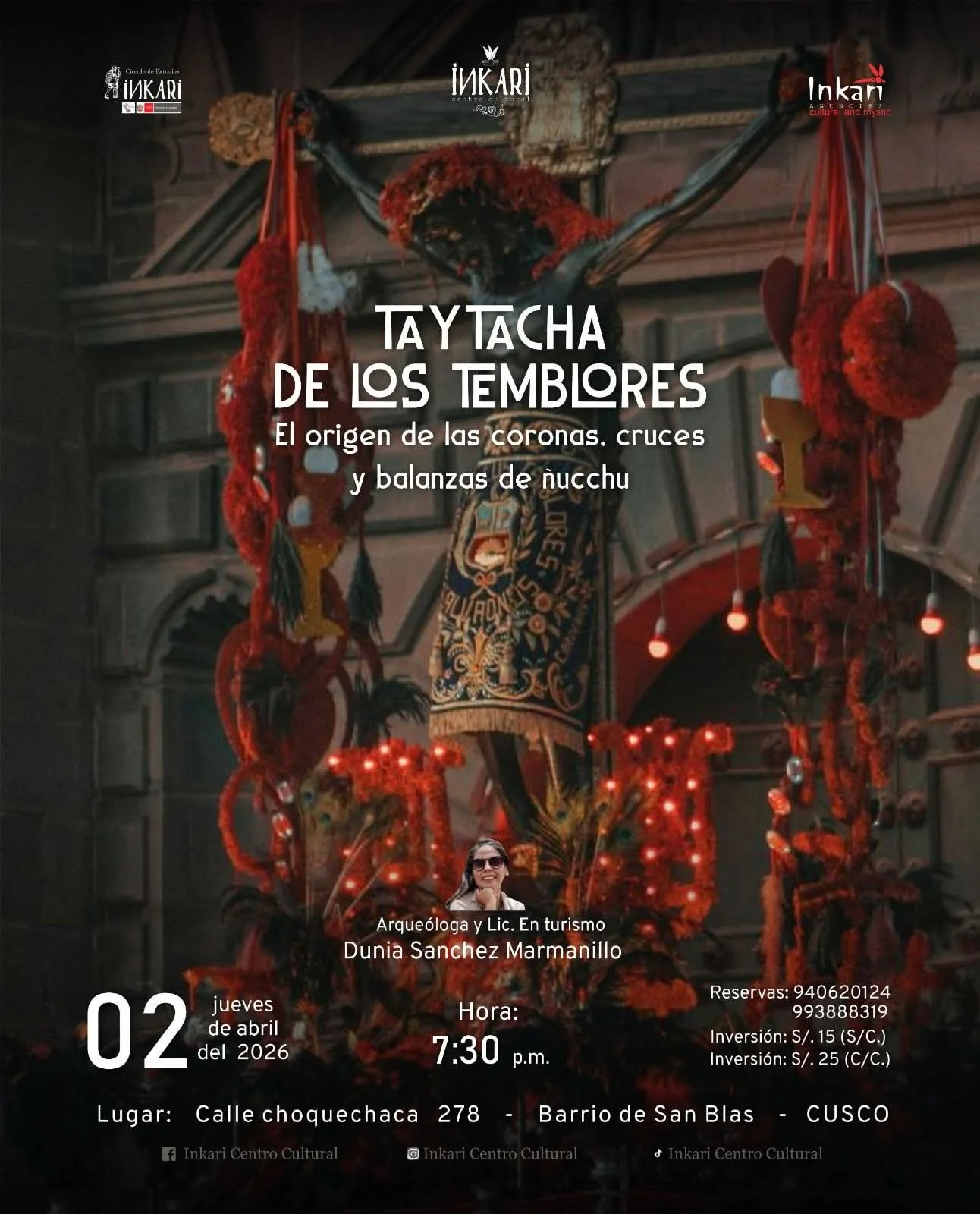
Dunia Sánchez is an anthropologist and tour guide who is an expert on Cusqueñian culture. Most of what I know about the ñucchu flower is from one of her lectures. You can find Dunia on Facebook or check with Inkari Cultural Center to attend one of her lectures in Cusco and meet her in person.